




Certificates
Completion certificates help learners, parents, caregivers, schools, and organizations show that safeguarding training was completed. More importantly, the training behind the certificate can build the confidence, awareness, and practical knowledge needed to take child safety concerns seriously and respond responsibly.
Why completion certificates matter
A certificate is more than a final document. It represents that a learner has worked through structured safeguarding training and has been introduced to important child safety topics such as online safety, personal safety, trusted adults, safe communication, reporting concerns, and getting help.
Proof of completed learning
A certificate provides a visible record that a learner completed the assigned training steps and participated in safeguarding awareness education.
Confidence to respond
Training helps people move from uncertainty to action by explaining what to notice, how to respond, who to contact, and why concerns should be taken seriously.
Useful training records
Certificates can help schools and organizations track participation, support onboarding, document refresher training, and encourage a stronger safeguarding culture.
The training builds the confidence behind the certificate
Many people care about child safety but feel unsure what to do when a concern appears. They may worry about overreacting, saying the wrong thing, missing warning signs, or not knowing who should be told. Safeguarding training helps close that gap.
- Helps learners recognize safety concerns earlier.
- Explains how to respond calmly and responsibly.
- Builds awareness of online safety, personal safety, boundaries, and trusted adults.
- Shows why concerns should not be ignored, minimized, or handled alone.
- Supports confidence to ask for help or follow the correct support pathway.
- Reinforces that safeguarding is a shared responsibility across families, schools, and organizations.
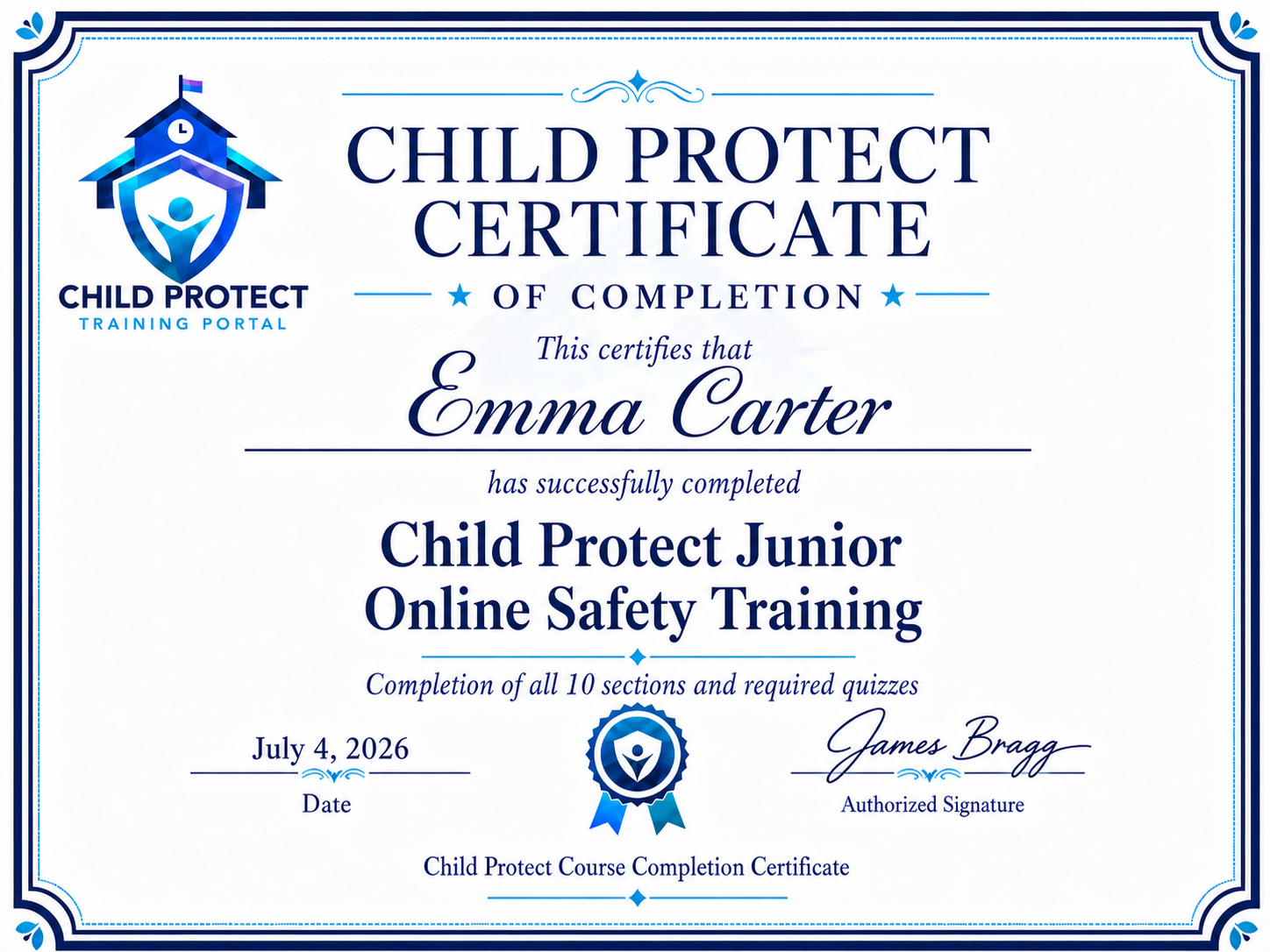
Certificate of Completion
A certificate of completion confirms training participation and completion within the Child Protect Academy. It is a record of completed learning, not a legal certification, professional license, formal child protection appointment, or guarantee of compliance.
Completion recognition
A certificate helps recognize that a learner completed the assigned training steps for a course or safeguarding topic.
Training records
Completion certificates can support internal training documentation, onboarding records, refresher training, and participation tracking.
Safeguarding awareness
Certificate recognition reinforces that child safety, trusted adults, online safety, personal safety, and getting help are important training topics.
How certificates support serious safeguarding action
A certificate does not replace judgment, policy, professional advice, or official reporting duties. It does, however, show that the learner completed training designed to improve awareness and preparedness.
For individuals
- Builds confidence to speak up when something feels wrong.
- Helps parents, caregivers, staff, and trusted adults understand their role.
- Provides a record of completed safeguarding awareness training.
- Encourages learners to take safety concerns seriously instead of ignoring warning signs.
- Supports better conversations with children about online safety, personal safety, and getting help.
For schools and organizations
- Supports staff onboarding and refresher training records.
- Helps demonstrate that safeguarding awareness training was assigned and completed.
- Creates a shared language for reporting concerns and seeking support.
- Helps teams understand that concerns should be documented and escalated through proper pathways.
- Strengthens a culture where child safety is treated as a serious shared responsibility.
What learners should understand before receiving a certificate
The purpose of training is not simply to reach the end of a course. The purpose is to help learners understand practical safeguarding actions that can be used in real situations.
Recognize possible concerns
Learners should understand that worries, unsafe communication, pressure, secrecy, boundary concerns, bullying, online risks, or uncomfortable situations may need support.
Respond calmly and safely
Training helps adults and learners understand that calm responses, careful listening, and responsible support are better than panic, blame, silence, or confrontation.
Know when to get help
Learners should know that safeguarding concerns should not be handled alone when a child may be at risk. The right support pathway matters.
Take the issue seriously
The training and certificate reinforce that child safety concerns deserve attention, documentation where appropriate, and responsible action.
Why confidence matters
People sometimes fail to act because they are unsure, embarrassed, afraid of being wrong, or do not know the correct pathway. Training can reduce hesitation by giving learners clearer knowledge, safer language, and practical steps. That confidence can help someone ask the right question, speak to the right person, document the concern, or support a child in a safer way.
How the certificate process works
Certificate availability depends on the training setup, course requirements, enabled activities, and completion settings.
Start the training
The learner begins an assigned course, such as online safety, personal safety, school safeguarding, parent training, caregiver training, or trusted adult training.
Complete the required learning steps
The learner works through lessons, activities, topics, and knowledge checks where enabled for the course.
Meet completion requirements
The system confirms that the learner has completed the required training steps based on the course configuration.
Receive completion recognition
When enabled, the learner may receive or access a certificate showing completion of the assigned safeguarding training.
Important certificate note
A Child Protect completion certificate is a training completion record. It should not be treated as a professional license, legal certification, formal child protection appointment, or guarantee of legal compliance. It supports awareness, preparedness, and training documentation, but organizations should still follow their own safeguarding policies and applicable laws.
Related training pages
Certificates connect directly with training progress, safeguarding topics, and the courses learners complete.
Training Progress
Understand how learners move through training steps and completion requirements.
Learn moreSafeguarding Topics
Explore online safety, personal safety, trusted adults, getting help, and safer learning.
Learn moreTraining for Organizations
Support onboarding, refresher training, completion tracking, and staff awareness.
Learn moreComplete training with confidence
Use Child Protect to build practical safeguarding awareness, support confident action, and provide completion certificates that recognize finished training where enabled.
View TrainingChild Protect Academy
Quick answers
How do learners earn a certificate?
By completing a whole course: watching every video lesson and passing each quiz in order. A digital certificate is then issued and the completed course is saved to the member’s record, where it can be viewed again later.
What does a certificate prove?
That the learner completed the course. It is not a professional licence, a legal certification, a child-protection appointment or a guarantee of compliance.
Can a school see its learners’ certificates?
Yes, through an organisation account, together with course progress and participation records.